Short answer
Aquaculture site selection in Atlantic Canada starts with measured data: bathymetry, current profiles over a full tidal cycle, wave exposure, seabed type and water quality, checked against provincial leasing policy. Mooring design then sizes anchors, grid lines and bridles for the worst conditions the site will see, with holding capacity verified for the actual seabed and a documented inspection program.
You have found a stretch of water that looks right: sheltered enough to work in, deep enough for the cages, close enough to the wharf. Before you spend a season on the lease application, two questions decide whether the site will make money or make headlines. Will the water support the fish, and will the moorings hold the gear when the weather turns?
In the Bay of Fundy, the Northumberland Strait and along the Atlantic coast of Nova Scotia and Newfoundland, those questions have different answers at sites a few kilometres apart. This article walks through how we approach site selection and mooring design, and what the regulators and your insurer will want to see.
What makes a good aquaculture site?
A site has to work for the animals, the gear, the operators and the regulator at the same time. The main criteria:
| Factor | What you are looking for | How it is measured |
|---|---|---|
| Depth | Enough clearance under the nets at low water, including spring tides | Bathymetric survey, corrected to chart datum |
| Current | Strong enough to flush waste and supply oxygen, not so strong it deforms nets or overloads moorings | Current meter or ADCP through a full spring-neap cycle, at several depths |
| Wave exposure | Fetch, prevailing storm direction, swell | Wave hindcast, local records, fetch analysis |
| Seabed | Type (mud, sand, gravel, bedrock), slope, anchoring potential | Grab samples, drop camera, sub-bottom or side-scan where needed |
| Water quality | Temperature range, salinity, dissolved oxygen, harmful algae history | Logged through at least one full year where possible |
| Ice | Drift ice and shore-fast ice in winter | Local records, operator experience |
| Access and conflicts | Navigation, commercial fishing, other leases, sensitive habitat | Charts, consultation, habitat survey |
Local knowledge is valuable; it is also incomplete. A fisherman knows where the water runs hard on an ebb tide. He may not know that the current at 15 metres depth runs at a different angle than the surface, which is what sets the load on a net pen.
How does the leasing process work in Atlantic Canada?
Each province runs its own system, and all of them sit on top of federal responsibilities for fish habitat (Fisheries and Oceans Canada) and navigation (Transport Canada).
In New Brunswick, marine aquaculture is governed by the Aquaculture Act and its regulations, administered by the Department of Agriculture, Aquaculture and Fisheries. Proposals are reviewed by an Aquaculture Site Evaluation Committee drawn from federal and provincial agencies, with consultation of existing licence holders, the commercial fishery and DFO, written notice to adjacent landowners and public advertisement. For Atlantic salmon in the Bay of Fundy, the province’s site allocation policy divides the bay into Bay Management Areas, requires single-year-class stocking with fallowing between cycles, and expects approved bay management agreements to be in place before new sites or production increases are approved. Sites are also subject to the provincial Environmental Monitoring Program and sediment standards.
In Nova Scotia, licences and leases are issued by the Department of Fisheries and Aquaculture, and new or enlarged marine cage finfish sites (outside a designated aquaculture development area) go through a public adjudicative hearing before the Nova Scotia Aquaculture Review Board, while shellfish and most other applications are reviewed administratively.
In Prince Edward Island, shellfish leasing is administered federally through DFO, which is a different path again.
Whichever province you are in, the reviewers are asking the same thing: has this proponent done the homework?
How do you design a mooring system that holds?
Mooring design is load estimation followed by component selection, in that order.
Step 1: establish the design environment
Collect the current, wave and wind data described above and settle on the design condition the system must survive over its service life. In Norway, NS 9415 (currently the 2021 edition with its 2024 corrigendum) sets out the site survey, load and component requirements for floating farms, and it has become the de facto reference for designers, insurers and suppliers worldwide, even where it is not law. In Canada it is not a legal requirement, but following it or an equivalent is the easiest way to show a lender or underwriter that the design is defensible.
Step 2: calculate the loads on the gear
Drag on nets is the biggest single load on a finfish system, and it changes with net solidity, fouling, current speed and the deformation of the net itself. Mussel longlines and oyster cages carry different load patterns, but the same principle applies: estimate for the gear fully loaded and fully fouled, at the worst current and wave combination, not for a new system on a calm day.
Step 3: lay out the grid
A grid mooring (a lattice of lines held by anchors on all sides, with cages attached at the nodes) shares load across many anchors and allows cages to be moved. Design the grid spacing and line angles for the gear you will have in five years. Grids are expensive to re-lay, and cages tend to get bigger.
Step 4: select anchors for the actual seabed
Drag embedment anchors, deadweight blocks, driven piles and rock bolts all have their place. Which one depends on the seabed under each anchor point, not on what was used at the last site. Holding capacity should be proven, by pull testing or by calculation against sampled seabed conditions, before the farm is stocked.
Step 5: detail the connections
Most mooring failures we have seen or reviewed trace back to a connection: a shackle without a mousing, a thimble that chafed through, a splice that was never inspected. Specify every connection, call for corrosion-resistant hardware where it matters, and design chafe protection into the lines at every point of contact.
Step 6: write the inspection and maintenance plan
The plan should state what gets inspected, how (diver, ROV, surface), how often, after what events, and what the replacement triggers are. If the plan lives only in the designer’s head, it does not exist.
What this looks like in practice
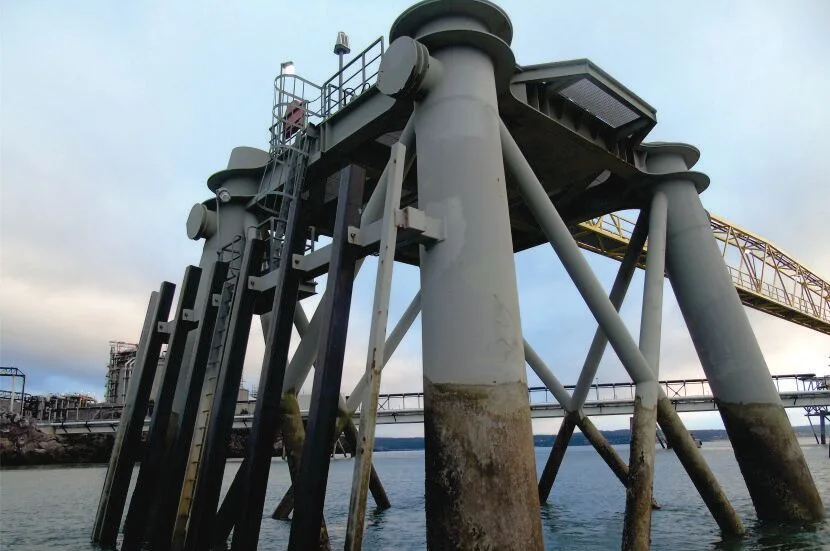
Our survey of the Canaport LNG multi-purpose pier at Mispec Point in the winter of 2014 and 2015 involved above-water and underwater inspection of a structure built to receive Q-Max LNG carriers, with divers working around strong tidal currents. The same current regime that complicates a diver’s day is what loads a net pen or a longline grid a few kilometres along the coast, and the same survey discipline, planned around the tide, is what produces usable mooring data.
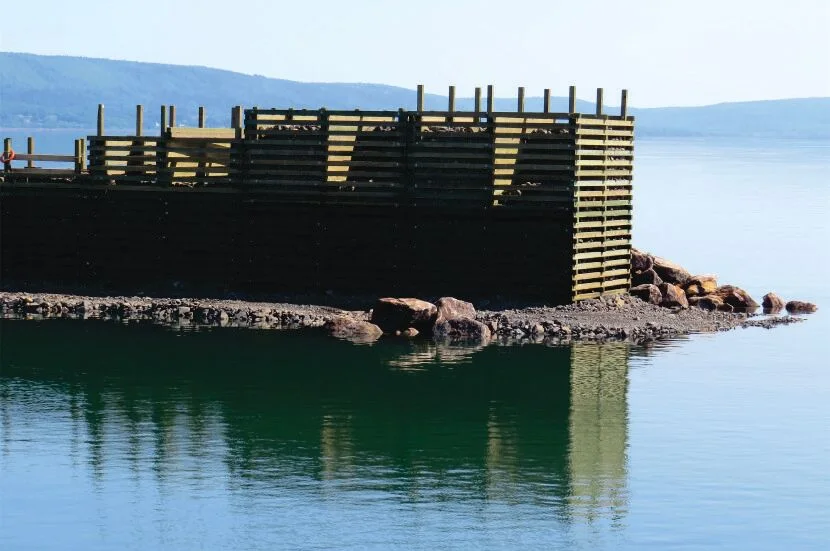
Marine structures also have to respect the seabed they sit on. At Digby Harbour in Nova Scotia, between 2008 and 2013, our team redesigned a 300-metre breakwater for poor soils, combining armour stone with timber crib and ballast. An anchor system for a fish farm is a smaller version of the same problem: the design has to match what is actually under the water, not what the chart implies.
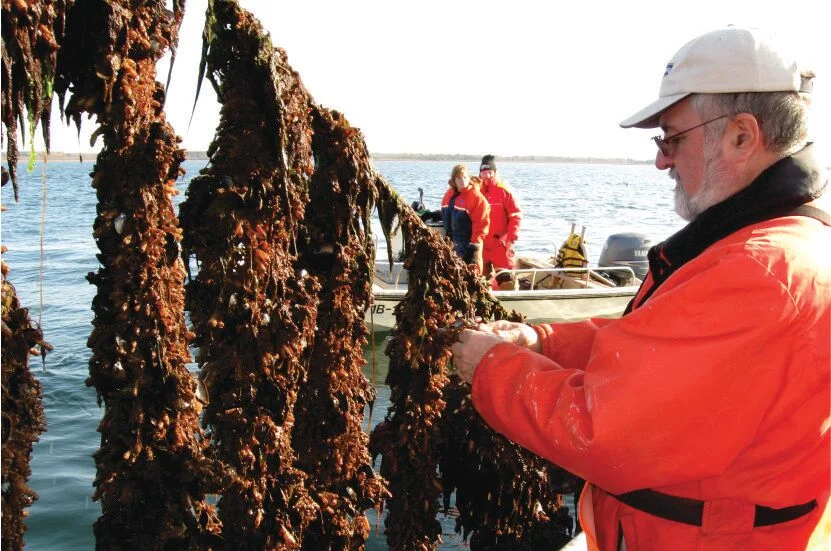
On the shellfish side, our work on tunicate control at PEI mussel farms, funded through the Atlantic Innovation Fund from 2008 to 2011, dealt with the fouling problem from the biological end. Fouling matters to mooring design too: invasive tunicates add weight and drag to mussel socks and lines, which is one more reason to design for the fouled condition.
Our bio-resources team has also carried out aquaculture technical due diligence across dozens of grow-out sites and processing plants for an institutional investor: a mooring report is read by bankers as well as engineers.
If your site work includes a wharf, slipway or shore base, the article on designing marine structures for the Bay of Fundy’s tides picks up where this one leaves off. And if the operation is heading for certification, GHG assessments for aquaculture explains what the auditors will ask for.
The bottom line
A good site is one you have measured, and a good mooring is one designed for the worst that site will do. In Atlantic Canada’s high-energy waters, the margin between a system that rides out a January storm and one that ends up on the shore is usually a few weeks of proper field data and a designer who was asked the right questions early. Spend the money on the survey first.
Key takeaways
- A site is only as good as the data behind it: a single current reading on a calm day tells you almost nothing about a Bay of Fundy lease.
- Mooring systems fail at the weakest component, usually a connection, a chafed line or an anchor that was never proven in that seabed.
- Provincial leasing in NB, NS and PEI runs on policy and committee review as much as on regulation, so the application needs to answer the reviewers' questions before they ask.
- Design the grid for the gear you will have in five years, not the gear you own today.
- Inspection and maintenance are part of the design, not an afterthought; a mooring plan without an inspection schedule is half a plan.
Questions we get asked
What data do I need to apply for a marine aquaculture lease in New Brunswick?
The Department of Agriculture, Aquaculture and Fisheries sets out the information requirements in its application guide, and proposals are reviewed by a site evaluation committee with federal and provincial members. Expect to provide site coordinates and layout, bathymetry, current and oceanographic information, seabed and benthic conditions, proposed species and production, and your financial and managerial capability. For Atlantic salmon in the Bay of Fundy, the site must also fit within the Bay Management Area framework. Confirm the current checklist with the Department before you start field work.
How strong do currents get at Bay of Fundy aquaculture sites?
It varies enormously from one cove to the next, which is exactly why you measure rather than assume. Sites near headlands and channel constrictions can see tidal currents strong enough to collapse net volume and drag poorly sized systems, while sheltered sites a few kilometres away are far calmer. A current meter deployed through at least one full spring-neap cycle, recording at several depths, is the minimum for design.
What is NS 9415 and does it apply in Canada?
NS 9415 is the Norwegian standard for floating aquaculture farms, covering site survey, loads, main components (enclosure, floater, raft and anchoring) and the user handbook. It is not law in Canada, but it is the most widely used reference for mooring design and site classification, and insurers, lenders and equipment suppliers often expect designs to follow it or an equivalent approach.
How often should aquaculture moorings be inspected?
At minimum, after every significant storm and on a scheduled cycle set by the designer, typically with a diver or ROV survey of anchors, connections and chafe points at least annually and more often on exposed sites. Shackles, thimbles and splices wear faster than the lines themselves, and a visual check from the surface will not find a shackle pin that has backed out two metres down.
Can an existing mussel or oyster site be converted to finfish?
Sometimes, but it is a new application in practice, not an amendment. Finfish cages carry much higher mooring loads than longlines, the site may need different depth and current characteristics for fish health and waste dispersion, and the provincial review will treat it as a new use. Get the site data assessed against finfish criteria before investing in an application.