Short answer
Ghost gear retrieval can serve as fish habitat offsetting when a project needs a Fisheries Act authorization and cannot avoid all harm to fish habitat. Derelict traps keep killing lobster; removing them restores productive seabed. The proponent must survey the gear, quantify the benefit against the impact, retrieve it under permit and monitor the result in a DFO-approved offsetting plan.
Your project needs a Fisheries Act authorization. You have avoided what you can, mitigated what you can, and there is still a patch of seabed that will be lost under a new pier, a pipeline trench or a dredge footprint. Fisheries and Oceans Canada (DFO) now wants an offsetting plan, and the usual options (build a reef, restore a salt marsh) do not fit the site or the budget.
There is another option we have used on the Bay of Fundy: find the lost lobster traps still killing lobster on the bottom, and take them out.
What does the Fisheries Act require?
The Fisheries Act prohibits causing the death of fish by means other than fishing, and the harmful alteration, disruption or destruction of fish habitat (known as HADD), unless DFO authorizes it. Authorizations are issued under paragraphs 34.4(2)(b) and 35(2)(b) of the Act, following the 2019 amendments that restored the HADD provisions.
DFO’s approach follows a hierarchy. You must first avoid impacts, then mitigate the ones you cannot avoid, and only then offset what remains. Offsetting means taking action that counterbalances the residual harm: restoring degraded habitat, enhancing existing habitat or creating productive habitat where there was none. DFO’s policy explicitly prioritizes restoration of degraded habitat.
An offsetting plan submitted with the application must describe:
- the offsetting measures, their objectives and how they counterbalance the residual impacts;
- the monitoring that will show whether the measures worked;
- the timeline and cost of implementation.
DFO also encourages proponents to involve Indigenous groups in planning and delivering the offset, and to align measures with regional priorities and species-at-risk recovery plans. The Department’s service standard is 60 calendar days to confirm an application is complete and 90 calendar days after that to decide, with the clock pausing in defined circumstances. Confirm current requirements with DFO before you build a schedule around them.
Why do derelict lobster traps count as a habitat problem?
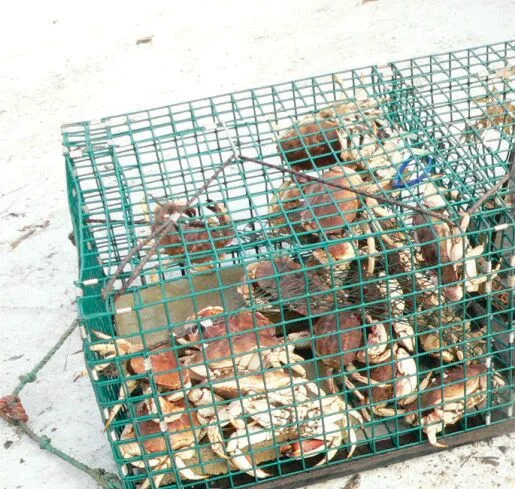
A lobster trap that breaks free of its buoy line does not stop working. It sits on the bottom, baited by whatever wandered in last, and goes on catching. The animals that die become bait for the next ones. A single trap can go on like this for years until the wire corrodes or the escape panel finally fails open.
From a habitat perspective, that trap does two things:
- It occupies seabed that would otherwise be productive bottom.
- It kills fish continuously, with no harvest and no management.
Removing it reverses both. That is the logic that allows retrieval to be framed as offsetting: measurable productive seabed returned to use, and ongoing fish mortality stopped.
Scale matters here. DFO’s lost gear reporting data from January 2020 to December 2025 record more than 24,000 lost gear reports across Canada, with lobster gear accounting for roughly 77 percent of them and the Maritimes and Gulf regions together making up about half. The problem is concentrated in exactly the waters where Atlantic Canadian marine projects get built.
How do you turn a retrieval into an offset?
The difference between a cleanup and an offset is documentation. An offset proves what it pulled, what it prevented and how that compares to the harm it is balancing. The process:
- Quantify the project impact. Area of seabed affected, habitat type, species using it, duration of loss. This is the debit side of the ledger and it comes from the habitat assessment done for the authorization.
- Survey for derelict gear. Side-scan sonar is the workhorse: it images the seabed in swaths and picks out the rectangular signatures of traps across large areas quickly. Targets are then ground-truthed with a drop camera or divers.
- Estimate gear density and condition. How many targets, how many are confirmed traps, and what share are still fishing (confirmed on retrieval by what is inside).
- Propose a retrieval program and a ratio. The offsetting plan states how many traps will be removed, the equivalent seabed restored, and the ratio of benefit to impact. DFO’s current policy does not publish fixed ratios; the ratio is justified case by case on the certainty of the benefit and the sensitivity of the habitat lost.
- Secure the permits and run the retrieval. Grappling and hauling from a fishing vessel, with divers where needed, under DFO authorization and in coordination with the local fishing association. Tagged gear goes back to its owner through DFO; the rest is disposed of or recycled on shore.
- Monitor and report. Count and condition of retrieved gear, contents, species and mortality, and follow-up survey to confirm the area stays clear.
What makes DFO say yes
DFO’s acceptance rests on three things: the benefit is real and measurable, it is in the same area and of the same kind as the loss, and it will last. Ghost gear retrieval does well on the first two. On the third, the plan should address how re-accumulation is handled, for instance by surveying again after a set period or by partnering with the local fishery on reporting.
What this looks like in practice
The project that taught us this approach was for Canaport LNG in 2008 and 2009, in Lobster Fishing Area 36 on the Bay of Fundy, near Saint John. The terminal’s marine works affected 2,445 square metres of seabed, and compensation was required under the fish habitat policy in force at the time (the mechanism was called compensation then; the principle is the same as today’s offsetting).
Our environmental team proposed retrieving derelict lobster traps as the compensation measure. A side-scan sonar survey covered 49.25 square kilometres of seabed and identified 2,971 potential traps. From those, 540 traps were retrieved. On recovery, 37 percent of the traps were still actively ghost-fishing, which gave the program hard evidence of the mortality it was stopping. The plan was approved by DFO in December 2009 at a compensation ratio of 4.5 to 1 against the 2,445 square metre impact.
Two lessons from LFA 36:
- The survey is the product. The sonar coverage turned a vague idea (“there are probably lost traps out there”) into a dataset DFO could review: locations, counts, densities. Without it, the proposal would have been an opinion.
- The fishery is a partner, not an obstacle. Lobster harvesters know where gear is lost, own the vessels that can haul it, and have a direct interest in clearing bottom that is killing their catch.
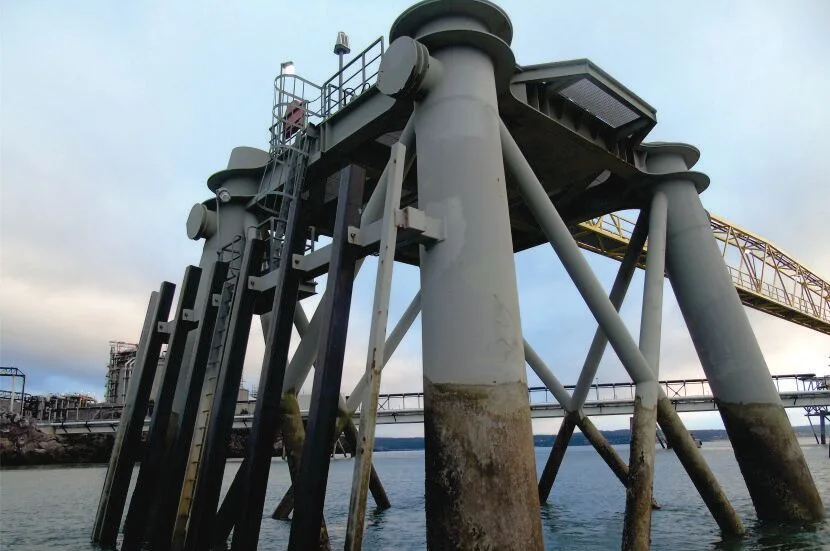
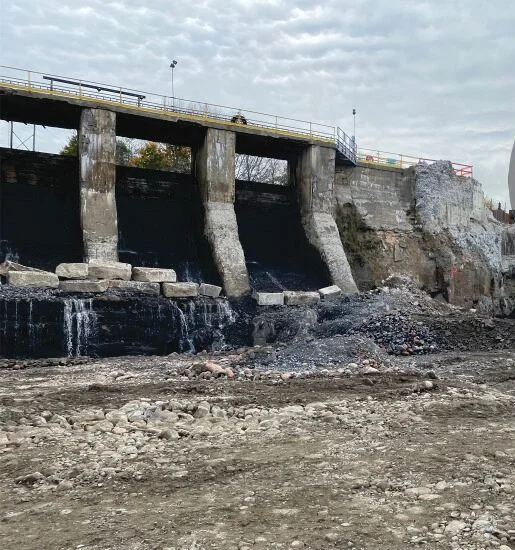
Bay of Fundy conditions make survey work demanding. Our later structural survey of the Canaport multi-purpose pier involved divers working through strong tidal currents, and sonar and dive planning for a ghost gear survey respects the same tide tables. On rivers the discipline is the same: the Milltown Dam removal on the St. Croix involved bathymetric, cofferdam and fish passage surveys as the 1881 dam came out.
When is ghost gear the right offset for your project?
It fits best when:
- the project is in or near an active trap fishery (lobster or crab);
- the impact is to subtidal seabed rather than, say, a salt marsh or an estuary where like-for-like restoration is more direct;
- there is a local fishing association willing to participate;
- the proponent wants a measurable, auditable offset with a clear completion point rather than a multi-year habitat construction program with uncertain establishment.
It fits less well where the lost habitat is a specific, scarce type (eelgrass, spawning gravel, intertidal wetland) that DFO will want replaced in kind. There, retrieval might form part of a package but is unlikely to carry it alone.
Marine projects in Atlantic Canada also need provincial permits. In New Brunswick, work below the ordinary high water mark triggers the Watercourse and Wetland Alteration permit process, and larger projects may need EIA registration as well. Our environmental team handles the full set, including the Fisheries Act authorization and the offsetting plan that goes with it.
The bottom line
Offsetting under the Fisheries Act does not have to mean building something. In trap-fishing waters, the most direct way to return productive seabed and stop fish mortality is often to remove the gear that is already there doing damage. Done with a proper survey, a quantified plan and the fishery on side, ghost gear retrieval is an offset that DFO has approved and that a project owner can actually finish.
Key takeaways
- Offsetting is the last step in the Fisheries Act hierarchy: avoid first, mitigate second, offset only what remains.
- Derelict lobster traps are not inert; in LFA 36, 37 percent of retrieved traps were still fishing.
- Side-scan sonar can map derelict gear across tens of square kilometres before a single trap is hauled.
- The offsetting plan has to show the math: area or productivity affected, benefit delivered, ratio, and monitoring.
- Lobster accounts for roughly three quarters of all lost gear reports in Canada, so there is no shortage of offsetting opportunity on the Atlantic coast.
Questions we get asked
What is ghost gear?
Ghost gear is fishing gear that has been lost, abandoned or discarded in the water and keeps catching animals with nobody tending it. Lobster and crab traps are the main type in Atlantic Canada. A lost trap can continue to fish for years, with animals that die inside becoming bait for the next ones, which is why the phenomenon is called ghost fishing.
When does a project need a Fisheries Act authorization?
When the work will cause the death of fish by means other than fishing, or the harmful alteration, disruption or destruction of fish habitat (HADD), and those effects cannot be avoided or fully mitigated. Authorizations are issued by Fisheries and Oceans Canada under paragraphs 34.4(2)(b) and 35(2)(b) of the Act. Marine terminals, wharves, dredging, pipelines, subsea cables and shoreline infill are common triggers.
How long does a Fisheries Act authorization take?
DFO's service standard is to tell you within 60 calendar days whether your application is complete, and to issue or refuse the authorization within 90 calendar days of confirming completeness. The clock can pause if DFO needs more information or consultation is ongoing, so a realistic plan allows considerably longer from first contact to approval, especially where an offsetting plan has to be designed and agreed.
Does ghost gear retrieval count as offsetting under the current DFO policy?
It can. DFO's 2019 offsetting policy allows measures that restore degraded habitat or otherwise counterbalance residual impacts, and removing gear that is actively killing fish and occupying seabed fits that description. Whether it is accepted on a given project depends on DFO's assessment of the impact, the species affected and the regional priorities, so the approach should be discussed with DFO early rather than proposed at the end.
Can I retrieve ghost gear without DFO involvement?
Not casually. Retrieving fishing gear that belongs to someone else, or disturbing the seabed to do it, generally needs authorization from DFO, and gear with identifiable tags is returned to its owner through DFO's process. Harvesters are also required to report lost gear to DFO. If retrieval is part of an offsetting plan, the permits are arranged as part of the authorization.